
Polychroma formed in early 2024,
and gave their first public performance later that same year at the Young Ensembles Competition of the London International Festival of Early Music, where they received the first prize. Several months later, they were chosen as the 2025-2026 Rheinsberger Hofkapelle, to be in residence throughout the season at the historic court of Prince Frederick in Rheinsberg, Germany. Now officially in their first full season, they will make appearances in London and around the Netherlands and Germany, presenting five unique programs of music by composers of the Rheinsberg court as well as Georg Philipp Telemann, Pietro Antonio Locatelli, and Jean-Marie Leclair.
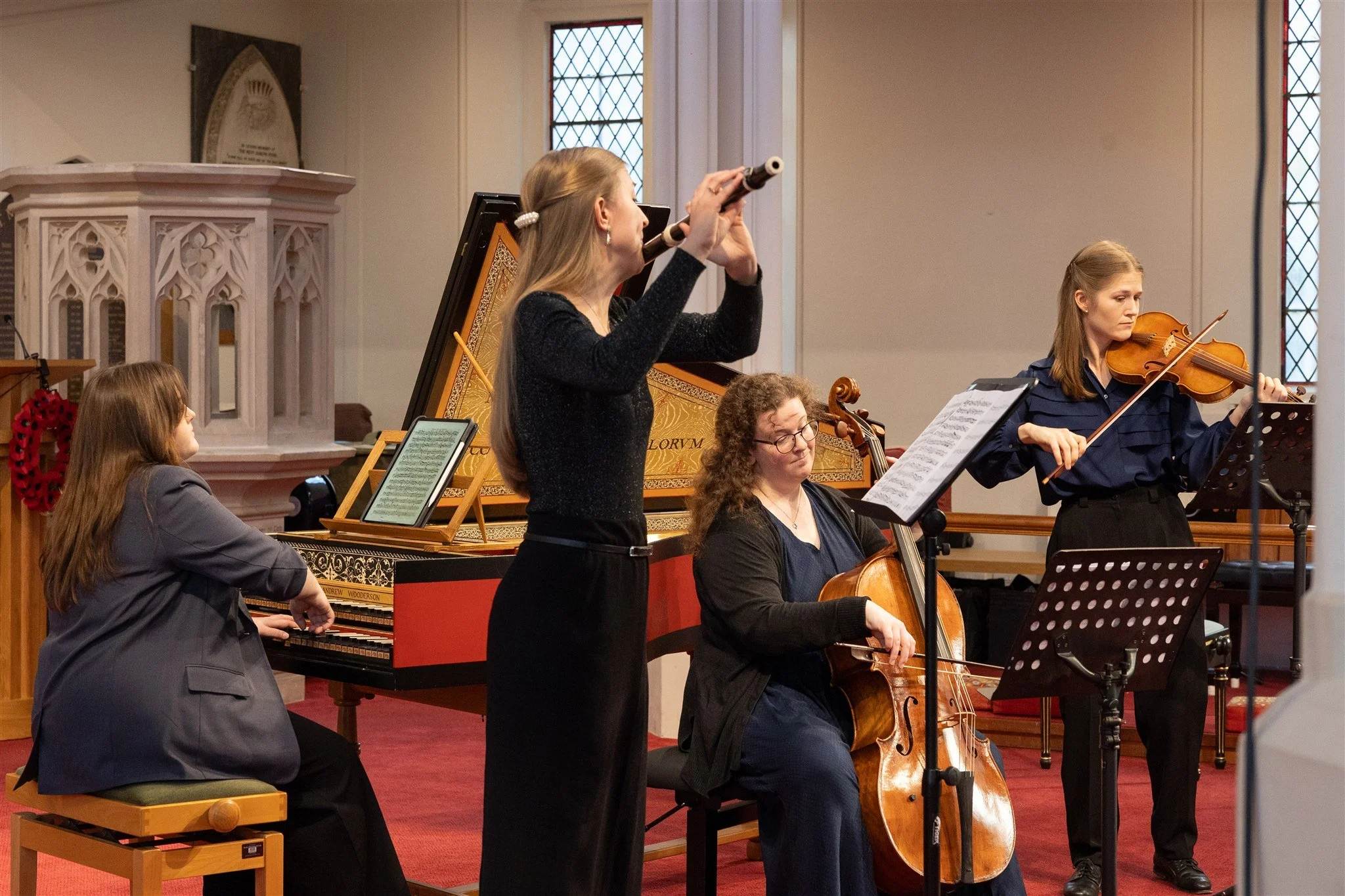
Performance at LIFEM 2025, photo by Anna McCarthy Photography
The ensemble is currently based in The Hague, Netherlands, where its members met while studying early music at the Koninklijk Conservatorium Den Haag. Drawn together by their mutual passion for historical performance and a desire to wrestle with even the tiniest musical details, they blend diverse musical, historical, and artistic interests. Their musical bond was formed through relishing the moments of extravagant chromaticism in the first repertoire they played together - trio sonatas by J. S. Bach and C. P. E. Bach - and while their focus has expanded beyond German repertoire, they still enjoy highlighting under-performed music, and make a point of crafting all their programs around a focus of unusual tonal colors.
The ensemble has immortalized this love of chromaticism through their name, Polychroma: it means “colorful,” or “multi-colored,” and is a reference to colors of all kinds, whether musical or visual. It is also a symbolic nod to the Greek goddess Iris, goddess of the rainbow and of communication - the messenger between heaven and earth. Consider the Pythagorean notion of “music of the spheres:” if music is humanity’s earthly taste of the heavens, here, the rainbow of color is the mode of transmission. Thus, Polychroma communicates through color.